Application review
We examine mounting height, ambient temperature, task geometry, target illuminance and maintenance access. That context helps narrow beam angle, luminous flux, CCT, CRI and enclosure choices before the schedule hardens.
Application engineering services
Lighting projects rarely fail because a fixture name is missing. Friction appears when mounting, photometric, electrical, controls and delivery information reaches different parties at different times. Our service path gives specifiers, contractors and procurement teams a shared set of checkpoints.

We examine mounting height, ambient temperature, task geometry, target illuminance and maintenance access. That context helps narrow beam angle, luminous flux, CCT, CRI and enclosure choices before the schedule hardens.
Project teams can request IES or LDT resources for candidate families. Designers remain responsible for final calculations, while our desk helps reconcile file selection, distribution labels and product configuration.
We document dimming protocol, sensor strategy and emergency requirements. DALI-2 and 0-10V are not interchangeable assumptions; driver compatibility and commissioning scope must be confirmed.
Schedules, requested options, available certifications and delivery milestones are assembled for review. Approval depends on the stated product configuration and authority having jurisdiction.

Project pattern: occupied retrofit
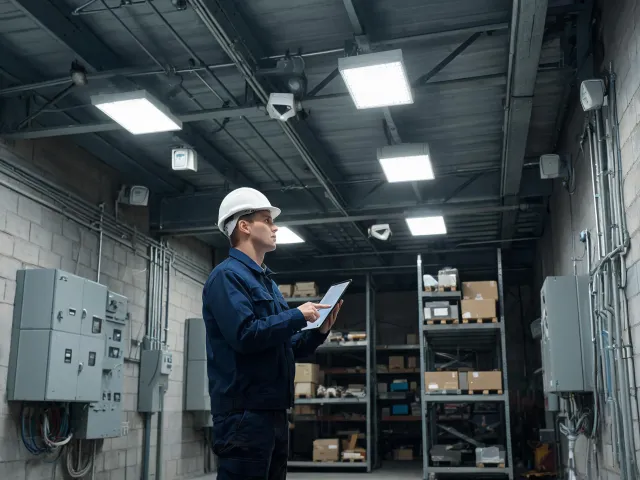
An operating warehouse may need installation windows, retained emergency circuits and aisle-specific optics. The service sequence records existing mounting points, voltage, controls and obstructions before a replacement is proposed. A sample bay can then be reviewed for horizontal and vertical illumination. Results from one bay should not be generalized where racking, reflectance or mounting height changes.
Project pattern: controls handover
Fixture supply, control hardware, network configuration and functional testing can sit in separate contracts. We help identify the luminaire interface and expected behavior so the controls engineer can build the sequence of operation. Site commissioning remains necessary because sensor placement, zoning and daylight conditions cannot be validated from a schedule alone.
Provide the site type, mounting height, voltage, target light level, controls strategy and procurement timing. We will organize the discussion around the decisions that can be verified before release.